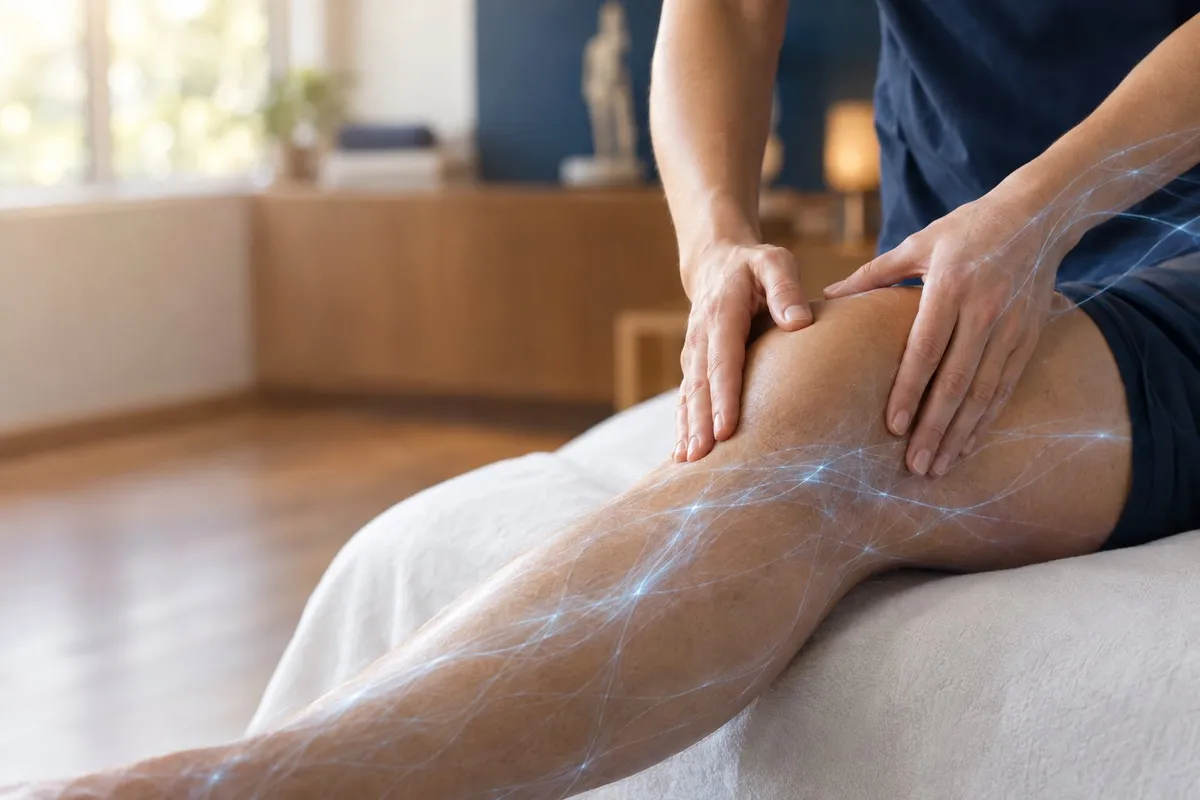
Sports & Orthopedic Therapy vs. Massage - What's the Difference?
When people hear “massage,” they usually picture a quiet spa room, soft music, and an hour of relaxation. That has its place. But that isn’t what happens when a 14-year-old pitcher comes in with a sore shoulder in the middle of the season, or when a client walks in six weeks after a knee replacement, trying to get their life back.
At Hands On Sports Therapy in West Des Moines, I practice sports and orthopedic therapy. It’s hands-on soft tissue work, but it starts with a question, follows a plan, and is built on an understanding of how the whole body holds itself together. And it’s probably much gentler than you expect. Here’s what that means, and why it matters if you’re an athlete, the parent of a young athlete, or someone getting ready for or recovering from an orthopedic surgery.
Three pounds of pressure or less
Most people assume that if a little pressure helps, more pressure helps more. In my experience, the opposite is true. Most of my work uses three pounds of pressure or less.
Here’s why. If I want to make long-term progress, I need your parasympathetic nervous system, the “rest and repair” side of your nervous system, to understand that I’m there to work with your body, not against it.
If I go in with too much pressure or force and cause pain, your brain shifts into the fight-or-flight response of the sympathetic nervous system. Your tissues brace and guard. From that point, it takes a lot longer to earn the trust of those tissues than if I had started out by asking permission and working with the body from the very first touch.
So I start gently, I listen to how your tissues respond, and I let your body tell me when it’s ready for more. Gentle doesn’t mean less effective. It means your body stays open to change instead of fighting it.
Precision, not force
One of my clients once called me a “bloodless surgeon.” I’ve always loved that, because it describes what this work really is: detailed precision rather than force. Instead of pushing harder, I work to find exactly the right spot, the right direction, and the right amount of pressure for your tissues on that day.
It starts with questions, not a routine
A relaxation massage tends to follow a routine: back, legs, arms, neck. Sports and orthopedic therapy starts with figuring out why something hurts or isn’t moving well.
Doug Nelson, founder of NMT Mid West and Precision Neuromuscular Therapy, whose training is part of my own background, puts it simply:
“Techniques are answers. An answer is only correct if it’s in response to the right question.”— Doug Nelson, LMT, BCTMB (Academy of Clinical Massage)
He describes asking himself two questions with every client: “what makes me think this is soft tissue?” and “what else would explain this?”(Academy of Clinical Massage). That kind of clinical reasoning is the backbone of this work. Sometimes the answer is a tight hip flexor. Sometimes it’s scar tissue from an old surgery. And sometimes the honest answer is, “this isn’t a soft tissue problem, and you need to see your doctor. ”Knowing the difference is part of the job.
Nelson also cautions that more pressure and more stretching aren’t always better, which fits the gentle approach I described above. Writing about heel pain, he notes that “overly aggressive treatment and stretching can potentially undermine” healing, and that "podiatrists, physical therapists, massage therapists—we all must use clinical reasoning skills to guide our approach to treatment”(AMTA Massage Therapy Journal).
Fascia: the body’s continuous connective web
To understand why this work is different, you need to know about fascia.
Fascia is the connective tissue that wraps, connects, and runs through every muscle, bone, nerve, and organ in your body. For a long time, anatomy students were taught to cut it away to see the “important” parts underneath. Today we know fascia is one of the important parts.
John Sharkey, a clinical anatomist based in Dublin, Ireland, and a senior lecturer with the University of Chester/NTC, has spent decades dissecting the human body with a special focus on fascia. I’ve been lucky enough to train with him. He describes fascia this way:
“It’s a continuous living connective tissue network… It gives coherence to the body. It gives adaptability to the body.”— John Sharkey, MSc, Clinical Anatomist (Savannah Alalia interview)
And:
“The human body is solid. So it is solid from skin to bone and back out to skin again… everything is in continuity.”— John Sharkey (Savannah Alalia interview)
That’s why pain doesn’t always show up where the problem is. A tight band of tissue in the hip can pull on the knee. An old ankle sprain can change the way you load your back. When everything is connected, you can’t just rub the spot that hurts and call it done.
Tensegrity: why the whole body matters
Sharkey’s work is built on a model called biotensegrity. It’s a way of understanding the body as a structure held together by a balance of tension (fascia, tendons, ligaments) and compression (bones), rather than a stack of blocks with hinges. In his words, "the language of Biotensegrity is tension and compression with continuity”(John Sharkey, Biotensegrity: The Fallacy of Biomechanics).
Think of a camping tent. Pull one corner too tight and the whole tent changes shape. Your body works the same way.
Opposite diagonals
If you’ve been on my table, you’ve probably heard me say "opposite diagonals". Your body is built to move in crossing patterns. When you walk, run, throw, or swing, your right arm moves with your left leg, and the left shoulder works with the right hip. Those connections cross the body like an X.
That means the source of a problem is often on the opposite diagonal from where you feel it. A right knee that won’t settle down may be tied to tension in the left shoulder or hip. So I don’t just work on the sore spot. I follow the line of tension across the body to where it actually starts.
From your jaw to your big toe
Here’s an example that surprises most people. If I don’t look at the whole body, I might miss that the muscles of the jaw that control the back of the tongue can have an impact on your gait and on control at your big toe.
It sounds far-fetched, but the anatomy backs it up. Dissections published by Anatomy Trains show one continuous chain of deep connective tissue that runs from the deep muscles of the lower leg, including the muscle that bends the big toe (flexor hallucis longus), up through the inner thigh, the hip flexors and the diaphragm, all the way to "that final, important, most forward muscle of the core, the tongue”(Anatomy Trains, Early Dissective Evidence). And that big-toe muscle is "very important in the 'push off ’part of the normal gait”(Texas Tech University Health Sciences Center, anatomy tables).
When everything is that connected, looking at the whole body isn’t extra. It’s the only way to find the real cause. That’s why Sharkey says therapists "may need to isolate their‘ attention’ and ‘intention’ on specific tissues, however, they must also integrate their work into a full body perspective”(Science of Massage Institute).
He goes further: “Knowledge concerning the continuity and specialization of connective tissues generally and fascia specifically is essential for Medical Massage therapists to ensure that informed therapeutic interventions can be provided to their patients”(Science of Massage Institute).
Why this matters for athletes
Young athletes put huge, repetitive loads on growing bodies. Sharkey points out that when running, the body handles“6 to 12 times your body weight” crashing down on the joints, and that the body’s tension-and-compression architecture is part of how it manages that load (Savannah Alalia interview).
He also believes “the majority of pain and injury that we treat in our clinical practice is due to lack of recovery”(Science of Massage Institute).
For the junior athletes I see, that means sessions are about more than loosening up sore muscles. We look at how the whole body is moving, find the areas that aren’t recovering, and work to keep small problems from turning into injuries that sideline them.
Why this matters after joint replacements and orthopedic repairs
Surgery saves joints and changes lives. But every incision cuts through layers of fascia, and Sharkey explains that this “disrupts the connective tissue, the fascia, and it can also then lead to scarring”(Savannah Alalia interview).
Scars also go deeper than most people realize. “You can see a scar on the surface, ”Sharkey says, but in dissection his team has “followed those scars… to incredible depths”(Savannah Alalia interview).
I’ve seen this with my own eyes. During a dissection lab with John Sharkey at King’s College London, I did exactly that: I followed scar tissue and watched it pull on tissue much further away than I ever dreamed possible. A scar isn’t just a line on the skin. It can tug on structures far from the incision. That experience is a big part of why a whole-body approach is so essential, especially after surgery.
The body tends to overbuild during healing, laying down extra connective tissue, and Sharkey says the goal is to “minimize the disruption to that area and try to make sure that the scar is anatomically correct, ”which is “done… through appropriate manual therapy with movement therapy as well”(Savannah Alalia interview).
The research is encouraging. A 2024 review of 11 randomized controlled trials with 940 knee replacement patients found that adding massage to standard rehab reduced pain at 7, 14, and 21 days after surgery and improved knee range of motion at 7 and 14 days. The authors concluded massage “can be used as an adjunctive treatment for rehabilitation” after knee replacement (Journal of Orthopedic Surgery and Research, via PubMed Central).
Important: this work supports your surgeon and physical therapist. It doesn’t replace them. I always work within your surgeon’s guidelines and timeline, and I’m happy to coordinate with your care team.
So, what’s the difference?
Relaxation massage | Sports & orthopedic therapy |
Goal is relaxation and stress relief | Goal is better movement, less pain, and recovery |
Usually follows a set routine | Starts with assessment and clinical questions |
Focuses on where you feel tension | Looks at the whole connected body, including fascia and scar tissue |
More pressure is often seen as better | Gentle, precise pressure (usually 3 pounds or less) that works with your nervous system |
Works on the spot that hurts | Follows opposite diagonals and connections, like jaw to big toe |
Same approach for most people | Tailored to your sport, surgery, and stage of healing |
Stands alone | Works alongside your surgeon, PT, coach, or athletic trainer |
Who I work with
My clients range from 9 months to 93 years old. Most of my work falls into three groups:
•Junior athletes, for injury prevention, in-season recovery, and getting back to play
•Orthopedic surgery clients, both preparing for and recovering from joint replacements and repairs
•Everyday people who want to move with less pain and feel at home in their bodies again
Athletes under 18 must have a parent or guardian present.
Ready to feel the difference?
If you or someone in your family has an injury, a surgery coming up, or a body that just isn’t recovering the way it used to, I’d love to help.
Book online with Hands On Sports Therapy or call 515-778-3100.
Hands On Sports Therapy · 3408 Woodland Ave, Suite 203, West Des Moines, IA 50266
This article is for general education and isn’t medical advice. Always follow your surgeon’s and physician’s guidance after surgery or injury.
Sources
•Doug Nelson, “Table Lessons,” Academy of Clinical Massage podcast: https://www.academyofclinicalmassage.com/podcast/44-table-lessons-with-doug-nelson/
•Doug Nelson, quoted in “Well-Heeled,” AMTA Massage Therapy Journal: https://www.amtamassage.org/publications/massage-therapy-journal/massage-for-heel-pain/
•John Sharkey, “Exploring the Uniqueness of Fascia, ”interview with Savannah Alalia: https://savannahalalia.com/exploring-the-uniqueness-of-fascia-interview-with-john-sharkey/
•John Sharkey, Person of the Month interview, Science of Massage Institute: https://www.scienceofmassage.com/2019/06/person-of-the-month-issue-2-2019/
•John Sharkey,“Biotensegrity: The Fallacy of Biomechanics, Part 2”: http://www.johnsharkeyevents.com/research/2015/12/23/biotensegrity-the-fallacy-of-biomechanics-part-2
•Thomas Myers, “Early Dissective Evidence,” Anatomy Trains: https://www.anatomytrains.com/wp-content/uploads/2012/07/dissection.pdf
•Texas Tech University Health Sciences Center, Anatomy Tables – Leg & Foot: https://anatomy.ttuhscep.edu/schemes/leg_tables.html
•Chen R. et al., “Massage for rehabilitation after total knee arthroplasty: a systematic review and meta-analysis of randomized controlled trials, ”Journal of Orthopedic Surgery and Research (2024): https://pmc.ncbi.nlm.nih.gov/articles/PMC11110294/
1
of 6
